Choosing the right material for bathroom partitions is one of the most critical decisions in any commercial project. Restrooms are highly prone to moisture and constant use, meaning the wrong material will lead to frequent problems and high maintenance costs in a short period. In the Saudi market, the three most common options are Medium Density Fiberboard (MDF), Polyvinyl Chloride (PVC), and High-Pressure Laminate (HPL). In this guide, we provide a comprehensive comparison to clarify the real differences and help you make the right choice for your project.
MDF: An Economical Choice but Impractical for Restrooms
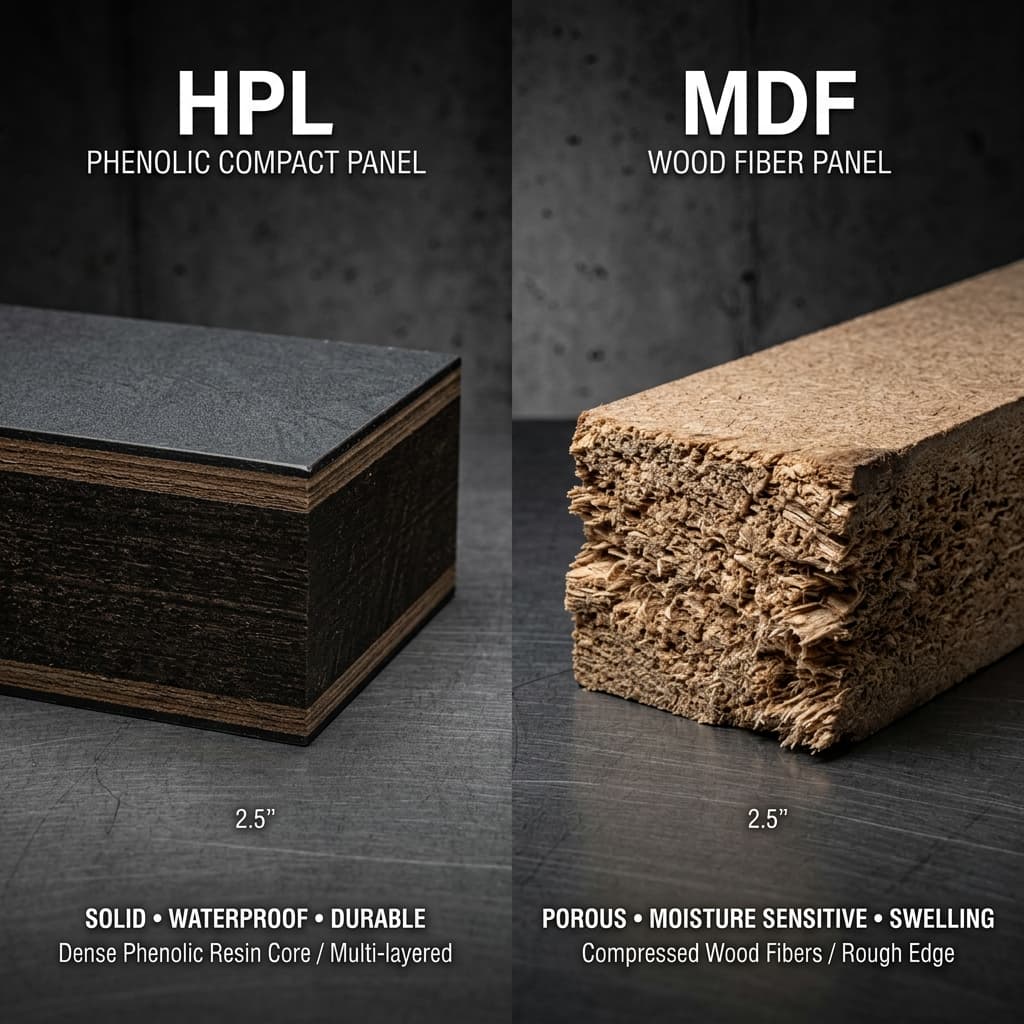
MDF panels are compressed wood boards widely used in furniture making due to their low cost and ease of shaping. Although they may be covered with a water-resistant surface layer (melamine), their edges and core remain highly susceptible to moisture absorption.
Why does MDF fail in restrooms? Once MDF edges are exposed to moisture or water leaks from the floor, the boards begin to absorb water and swell like a sponge. In high-use humid restrooms, surface damage and hinge looseness can appear quickly if edge protection and installation are not excellent. Despite its cheap initial price, constant replacement costs make it the most expensive option in the long run.
PVC: Waterproof but Lacks Durability and Professional Appearance
PVC panels are plastic boards known for being lightweight and completely waterproof, making them a common choice for wet environments.
Weaknesses: Despite being waterproof, PVC suffers from several issues that make it unsuitable for professional projects. First, it is a relatively soft material that cannot withstand impacts and heavy use in public restrooms, leading to breakage or bending. Second, it may react with heat and chemical cleaning agents, beginning to yellow and lose its color after extended use. Third, it lacks the premium and professional look required by commercial malls, hospitals, or large corporations, often appearing economical and negatively reflecting on the facility's overall evaluation.
HPL (Compact Phenolic): The Strategic Choice for Durable Projects
HPL (High-Pressure Laminate) or Compact Phenolic panels are high-density boards made by compressing multiple layers of resin-impregnated kraft paper under very high temperatures and pressure, resulting in a board as solid as stone.
Why is HPL a stronger choice? HPL partitions combine high moisture resistance, better hardness than many wood and plastic alternatives, and a non-porous surface that is easy to clean. However, long-term performance does not depend on the material alone; it also relies on choosing the appropriate thickness, hardware, installation quality, and post-delivery cleaning methods.
Comprehensive Comparison Between the Three Materials
| Criterion | MDF | PVC | Compact HPL |
|---|---|---|---|
| Water & Moisture Resistance | Very Poor (Swells) | Excellent | Excellent when choosing the right compact |
| Durability & Impact Resistance | Medium | Poor (Bends and breaks) | Very High |
| Scratch Resistance | Medium | Poor | Very High |
| Tolerance to Cleaning Chemicals | Leads to surface damage | Leads to yellowing | Excellent |
| Hygienic Environment (No bacterial growth) | Harbors bacteria if rotted | Good | Excellent (Non-porous surface) |
| Professional Appearance | Good initially only | Ordinary / Economical | Premium and Excellent |
| Expected Service Life | 6 - 18 months | 2 - 3 years | Affected by thickness, hardware, and use |
| Long-Term Cost | Very High (Continuous maintenance) | Medium to High | Very Economical (One-time investment) |
Conclusion: The Smart Choice for Your Project
If your goal is solely to save initial costs, MDF might seem like an option. If you are looking for moisture resistance at a low cost and are willing to compromise on durability and professional appearance, you might consider PVC. However, if you are looking for a practical solution for high-use projects with a professional look and lower long-term maintenance costs, Compact Phenolic HPL is often the strongest choice when specified correctly.
Frequently Asked Questions
When is HPL a better option than MDF?
HPL is usually better for humid, high-use environments where frequent replacement would be disruptive or expensive.
Is PVC suitable for malls or hospitals?
It can work in some budget-sensitive use cases, but HPL is typically stronger when durability and a premium look matter.
What information do you need for pricing?
City, cubicle count, dimensions, finish, hardware, and whether the scope is supply only or supply with installation.